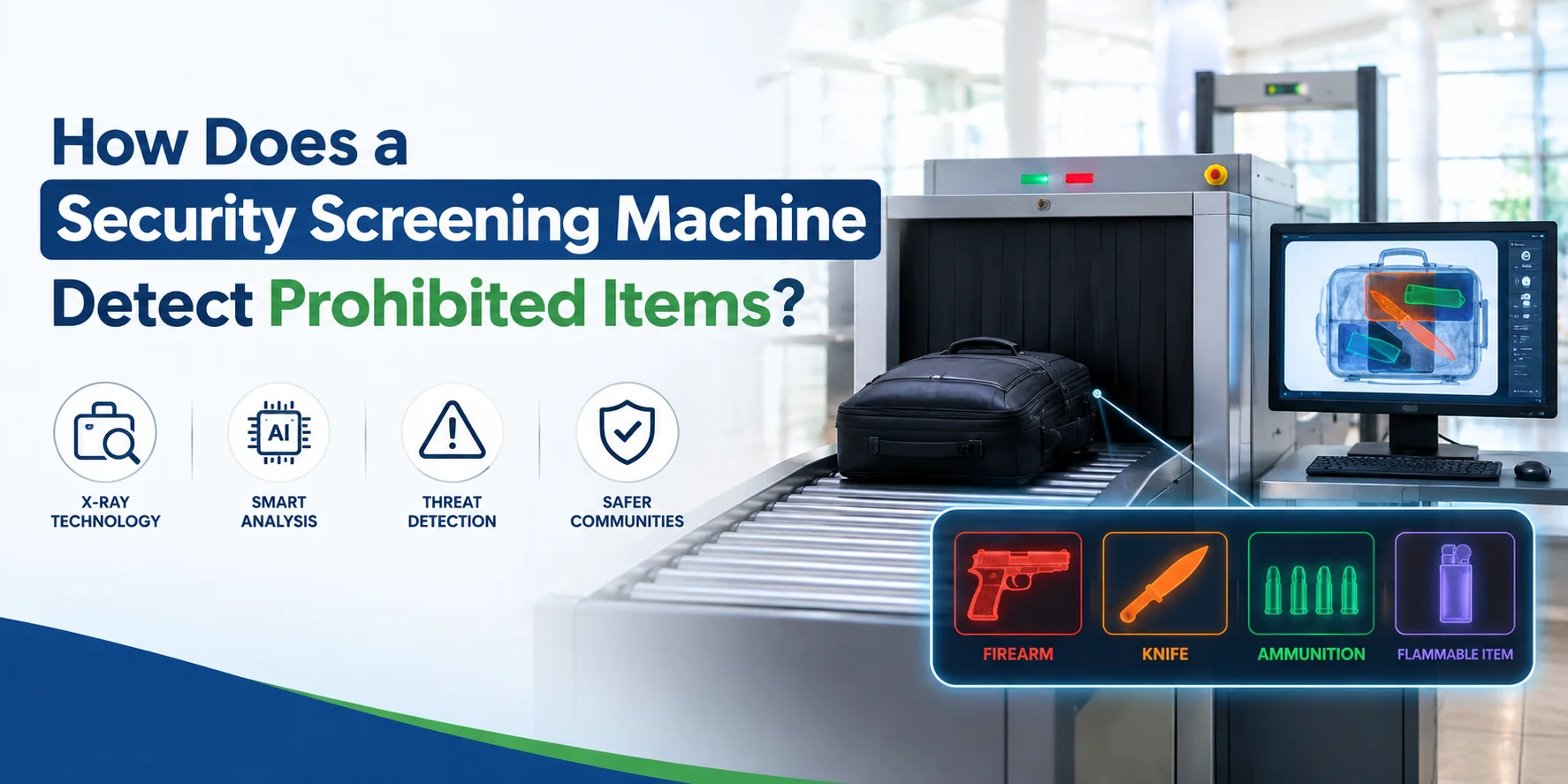
A security screening machine detects prohibited items using X-ray technology. The machine scans the content of a bag, parcel, or luggage. Security officers analyze the image created by the machine.
This approach helps inspect baggage in airports, railway stations, offices, malls, government buildings, warehouses, and other events.
1. The Bag Is Placed on the Scanner Conveyor Belt
A bag to be screened is placed on the machine’s conveyor belt. The bag then moves through the machine’s tunnel.
Using a controlled X-ray beam, the machine scans the bag without opening it. During this time, X-rays pass through the outer material and interact with the objects inside the bag.
As a result, this approach allows checking the objects that may be packed under clothes, documents, food packages, electronics, or other belongings.
2. Different Materials React to X-Rays Differently
X-rays are absorbed, reflected, and transmitted depending on the material. Every material interacts with the X-rays differently.
For instance, clothing, paper, plastic, food products, and most liquids are less dense. Such materials allow more X-rays to pass. Metals, batteries, dense tools, weapons, and dense electronic components block more X-rays.
Sensors of the machine calculate how much X-ray passes through the different parts of the bag. Based on the results, the machine creates an image on the operator’s screen.
3. The Machine Creates the Color Image
Usually, modern X-ray scanners create color images. Different colors allow distinguishing the type of material inside the bag on the image.
Materials like food, paper, fabric, leather, plastic, and other liquids may appear orange on the screen. Metals may appear blue. Mixed or dense materials may be green, black, or darker.
Color may vary from machine to machine but the goal is always the same – to help security staff distinguish ordinary items from objects requiring closer inspection.
4. The Machine Shows Suspicious Shapes and Materials
The machine does not search for just one prohibited object. The machine allows to find suspicious shapes, abnormal density, and hidden components.
For instance,
- A knife will be detected as a sharp, long metal item.
- A gun may be recognized as a metal item with a specific shape and details like barrel or trigger area.
- Ammunition is recognized as dense metallic objects gathered in groups.
In the same way, other suspicious items may be detected: wires attached to batteries, dense components hidden under clothing, unknown powder, sealed containers, or items with unusual shapes. An image of a bag will help to examine them regardless of the external appearance of a bag.
5. Operator Reviews the Image
The operator examines the image produced by the machine and compares the contents with regular belongings of a passenger.
For instance, keys, chargers, laptops, cameras, tools, and water bottles may seem unusual on the screen but they are not dangerous. In case there is a blade, weapon-like shape, hidden metal item, or unknown dense item, the operator asks for closer examination.
This may require the operator to open the bag or use other methods for detection.
6. Additional Checking Is Made If Needed
When the operator sees an unclear or suspicious image, the bag goes for an additional check. Security personnel ask the bag owner to open the bag and describe its contents.
This step is required since some prohibited items may be hidden in regular objects. While the scanner can help determine which part of the bag should be inspected, the physical check helps to recognize whether the item is allowed or prohibited.
Baggage Scanner Machine makes the entire process faster and more systematic.
Conclusion
Security screening machines use X-ray technology to create detailed images of baggage and help identify unusual shapes, densities, and materials without opening the bag. From scanning the contents to reviewing the generated image, each step supports faster and more systematic security checks. However, the final decision about whether an item is prohibited generally requires assessment by trained security personnel and, when necessary, additional inspection.
Want to know more about how security screening technology works? Read this blog to explore the application of X-ray baggage scanners in modern security screening.
Frequently Asked Questions
Yes. The machine uses X-rays to create an image of the content inside the closed bag, parcel, or suitcase.
Yes. Security scanners can detect metals as well as plastics, papers, liquids, fabrics, foods, and other organic substances.
The machine recognizes suspicious shapes and materials, but the operator decides what needs additional checking.
Different colors help the operator to recognize material types based on density and X-ray absorption level.
The bag is sent for additional inspection, where security personnel inspect it manually or use additional detection equipment.