Food safety is no longer just a ‘tick box’ requirement for manufacturers and producers. It has become an essential part of the day-to-day operation of many food businesses. The government is tightening the food safety regulations. Consumers are more educated and have become aware of food quality compared to a decade or so ago.
This leads to challenges for food companies, as thousands of products pass through the production lines every hour, and even a small percentage of contaminants may go undetected if the inspection processes are ineffective.
This is where modern X Ray Food Inspection Systems come into play. These advanced techniques help food producers detect contamination risks early and maintain strict quality control throughout the production process.
Let’s check in this post how innovative screening systems help prevent food contamination risks and improve overall food safety.
What Is Food Contamination?
Food contamination is when undesirable substances are present in the food product being manufactured or processed. It may arise due to equipment failures, environmental factors, or human error.
The three main types of food contaminants are as follows:
- Physical Contamination: Foreign objects like small glass particles, metal particles, plastic, or stone particles get mixed with the food product.
- Chemical Contamination: Cleaning chemicals, lubricating oils, or pesticides are mixed.
- Biological Contamination: Virus, bacteria, or other microorganisms develop.
Food manufacturers face plenty of issues when it comes to dealing with food contaminants. This may pose a threat to the overall reputation of the company as a whole.
What Are Innovative Screening Systems?
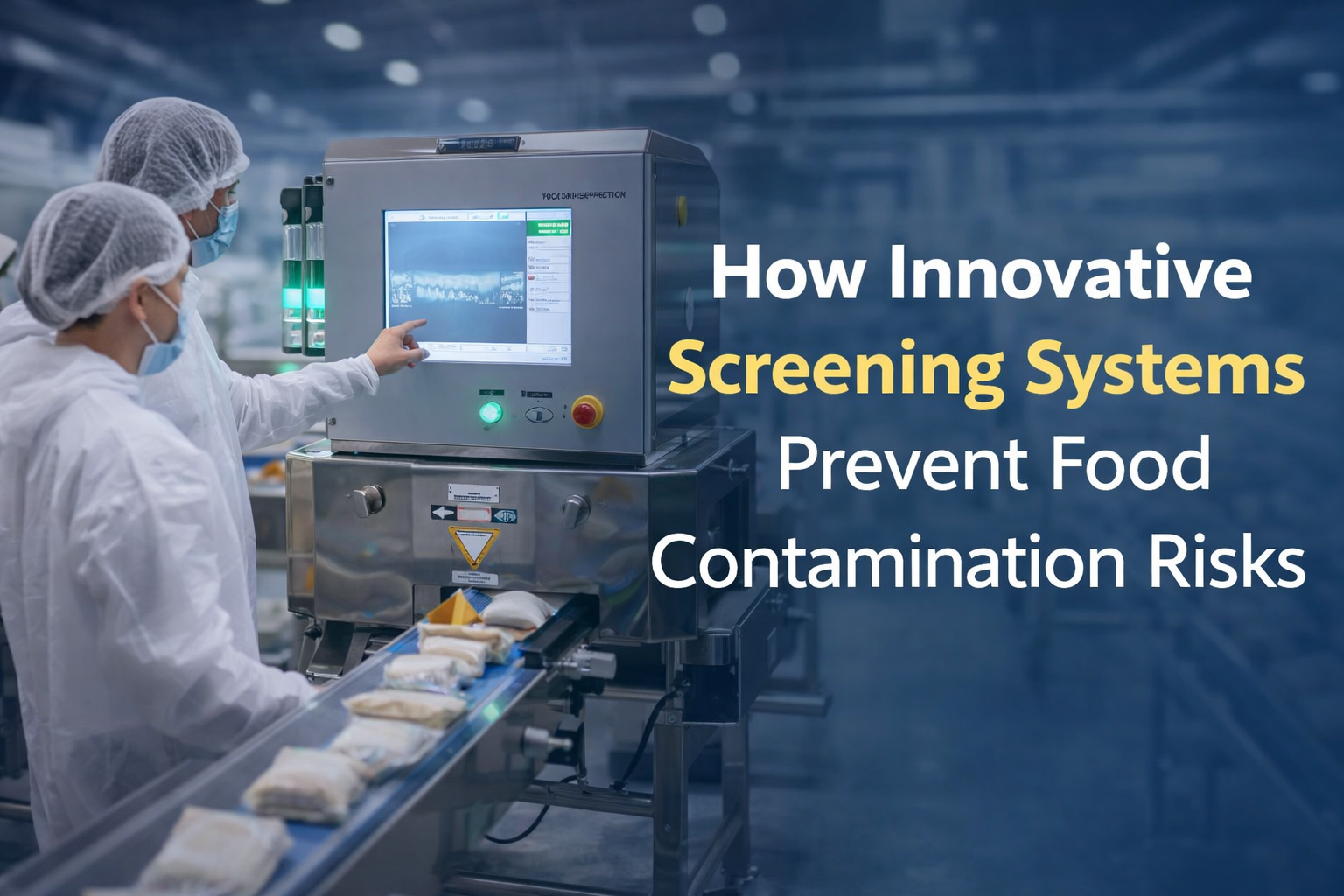
Innovative screening systems like (X Ray Food Inspection Systems) are a type of advanced mechanism to discover harmful particles, substances and defective products during the food production process. It allows experts to pick up any products that do not meet the safety standards set. Compared to traditional metal detectors, innovative systems provide deeper inspection capabilities and can pick up a wider range of contaminants.
Common features of innovative systems:
- Real-time scanning of products
- Computerised record keeping of results
- Automatic rejection of defective products
- Ability to handle different products
How Advanced Detection Technology Works
- The products move along the conveyor belt, passing through the inspection tunnel (the tunnel is installed in the production line.
- The system scans the products and looks for unusual density patterns that could indicate a contaminated product.
- The contaminated products are automatically pushed off the production line into the rejection bin.
All the results of the inspection are recorded in digital form. This allows the manufacturer to keep the required documentation for the food safety audit.
With the Modern X-Ray Food Inspection Systems, food producers can easily find metallic as well as non-metallic food contaminants such as glass, stones, bones, and plastic materials. The best part? There is no damage to the sealed packages.
Key Features of Modern Food Screening Systems
|
Feature |
What it Means for Food Manufacturers |
|
High Precision Detection |
Even small contaminants can be detected during inspection. |
|
Automated Rejection System |
Defective products are immediately removed from the production line. |
|
Hygienic Machine Design |
Food-grade machines are easy to clean and maintain. |
|
Real-Time Monitoring |
Instant results are available for viewing on digital displays. |
|
Recording and Reporting |
Data recorded for review purposes during safety audits. |
| Multi-Product Compatibility |
Compatible with a variety of product sizes and packaging types. |
With the combination of all these characteristics of Modern Food Screening Systems, the inspection process becomes much more efficient than the simple inspection method. Food manufacturers are able to have better control over their products, and the manufacturing processes remain efficient.
Benefits of Implementing Food Screening Solutions
There are several reasons why food manufacturers use these Advanced Food Inspection Systems, as discussed below:
- Reduced Risk of Product Recall
- Enhanced Compliance with Food Regulations
- Increased Efficiency
- Less Reliance on Manual Inspection
- Enhanced Brand Image
With the implementation of Modern Food Screening Systems for detecting contaminants in the products, the manufacturers are able to take corrective action much earlier in the manufacturing process rather than waiting until the quality control checks are performed at a later stage in the manufacturing process. This helps in reducing the number of defective products that are moved forward in the manufacturing process and also helps in avoiding surprises for the manufacturers when the quality control checks reveal defects in the product.
As the manufacturing processes become efficient, the customer satisfaction levels also increase, as the retailers and distributors become more comfortable working with manufacturers who ensure that the food products are safe.
Industries That Benefit Most
There are a number of industries in the food processing industry where the use of inspection technology is critical. Some such industries include:
- Dairy Processing Plant
- Meat and Poultry Processing Units
- Grain and Rice Processing Companies
- Packaged Food Manufacturing Companies
- Seafood Processing Companies
Food Processing Companies that export their products require inspection technology solutions, which are critical in these businesses.
With the implementation of inspection technology, the companies are able to meet the international standards that require a much higher level of inspection.
Choosing the Right Technology Partner
This is not an easy process, but a lot of planning is required, especially when it comes to safety. This means that a technology partner has to be chosen carefully, especially when it comes to inspection technology solutions.
- Make sure that the company has experience in installing a safety system that can function every day without any hiccups.
- Ensure that the company offers custom solutions to meet your specific needs and requirements
- Make it certain whether the technology partner provides solutions in the food processing industry that deal with a variety of products.
Gujar Industries specialises in the provision of inspection technology solutions that are critical to the food processing industry while at the same time helping these companies comply with safety regulations.
Future Trends in Food Inspection
Food inspection technology has continued to grow significantly, especially when it comes to the use of technology in the food processing industry. Some of the trends that are currently being seen in this sector, especially when it comes to inspection technology solutions, include:
- The use of artificial intelligence in inspection analysis
- The use of higher definition images in inspection technology solutions
- The use of smart technology in production monitoring
- The use of automated production management systems
- Faster inspection technology solutions
Conclusion
Food contamination is a major issue in the world, especially in terms of food processing companies. This means that inspection solutions are a major part of these businesses.
Innovative technologies in screening help in the early detection of impurities, which in turn helps in avoiding the risks associated with product recall and in maintaining a consistent level of food safety standards.
As the food industry is becoming more and more modernised, the use of innovative technologies in inspection will be a crucial factor in building a safe and efficient food chain.
For companies looking to improve their quality control mechanisms, investing in innovative inspection technologies is a step in the right direction.
Frequently Asked Questions
Q-1: What is the purpose of food screening systems?
Ans.Food screening systems inspect the products during the manufacturing process and find impurities in the products.
Q-2: Can these technologies detect non-metallic impurities in the products?
Ans.Yes, these technologies can detect impurities such as stones and glass. bones, and plastics in the products.
Q-3: Are these technologies efficient in detecting impurities in products during high-speed manufacturing processes?
Ans.Yes, the latest technologies in inspection are efficient in detecting impurities in products during high-speed manufacturing processes.
Q-3: Do these technologies help in export compliance?
Ans.Yes, these technologies help in export compliance, as many countries require rigorous inspection of food products.
Q-3: How often do the inspection technologies need to be calibrated?
Ans.These technologies need to be calibrated according to the manufacturing requirements, and the calibration may be done on a daily and/or weekly basis.
Q-3: Can these technologies be used to inspect packaged products?
Ans.Yes, these technologies can be used to inspect packaged products without opening the package.